
Indian benchmark indices closed mixed, with the Sensex gaining 113.61 points to 78,079.96 and the Nifty falling 40.10 points to 24,395.85, as elevated crude prices and ongoing geopolitical uncertainty in the Middle East made investors cautious.

The combined market valuation of five of India's top-10 most valued firms eroded by Rs 1 lakh crore last week, with IT giant Tata Consultancy Services (TCS) experiencing the largest decline amidst a bearish trend in domestic equities.

Flexi-cap mutual fund schemes have attracted nearly Rs 50,000 crore in net inflows during January-July 2026, a 27 per cent increase year-on-year, as investors increasingly favour dynamic equity strategies.

'I don't really expect the August increase in food prices, which was close to 6 per cent, to persist as we go close to the end of this year.'

Indian companies, including NBFCs, filed proposals with the RBI to raise $6.08 billion through external commercial borrowings (ECBs) and foreign currency convertible bonds (FCCBs) in June, marking a significant increase from the previous month.

India has attracted foreign direct investment (FDI) worth approximately 4,896 crore across 29 projects since May, following the government's relaxation of norms under Press Note 2 of 2026. The revised rules permit investment without government approval from entities with up to 10 per cent non-controlling ownership by land-bordering countries.

Indian information technology (IT) stocks, led by Infosys, experienced a significant selloff, dragging the Nifty to a two-month low, primarily due to escalating West Asian tensions pushing crude oil prices higher, and concerns over upcoming large IPOs diverting funds from secondary markets. The sector is also grappling with the long-term implications of AI disruption.

A committee formed by West Bengal's BJP government is considering proposals to rename several prominent roads, bridges, and public places in Kolkata, including those named after communist leaders Vladimir Lenin, Karl Marx, and Ho Chi Minh. This move has sparked sharp criticism from the Trinamool Congress and CPI(M), who view it as "vendetta politics" and an attempt to disrespect differing ideologies.

Indian banks and non-banking financial companies (NBFCs) are undertaking a comprehensive review and reset of their engagement terms with fintech firms, driven by the Reserve Bank of India's (RBI) draft Guidance on Regulatory Expectations for Data Governance and the stringent compliance requirements of the Digital Personal Data Protection (DPDP) Act, 2023, and its 2025 Rules.

Indian banks anticipate a reduction of up to 50 basis points in their funding costs due to a surge in liquidity from robust Foreign Currency Non-Resident (Bank), or FCNR (B), flows, lessening their reliance on more expensive certificates of deposit (CDs).

Despite near gender parity in basic bank account ownership, women in India remain significantly underrepresented in the growing platform economy due to gaps in digital financial capability and access to credit, according to a joint report by the International Labour Organization and National Council of Applied Economic Research.

Smallcap and midcap funds now account for nearly 30% of active equity MF folios, as stock-market gains revive investor appetite for high-growth segments.
Fitch Ratings forecasts a 9 per cent aggregate revenue increase for rated Indian corporates in the current fiscal year (FY27), a stronger outlook compared to the 5 per cent estimated for FY26, which is expected to keep credit metrics stable despite potential global and domestic challenges.

Inflows into non-resident Indian (NRI) deposit schemes decreased by 23.24 per cent to $2.78 billion during the first quarter of FY27, down from $3.61 billion in the previous year, according to Reserve Bank of India (RBI) data.
The divergence between the Sensex and Nifty closing values narrowed on the third day of the Closing Auction Session (CAS) rollout, but market participants, including Zerodha's Nithin Kamath, highlight structural issues and the unfortunate timing of its introduction alongside new RBI norms.

India's urban unemployment rate for individuals aged 15 and above marginally increased to 6.7 per cent in April-June, while rural unemployment rose to 4.8 per cent, according to the latest Periodic Labour Force Survey (PLFS). This rise in unemployment coincides with a notable decline in the overall labour force participation rate (LFPR) to a five-quarter low of 54.6 per cent.

India's outward foreign direct investment (FDI) plummeted by 47.9 per cent year-on-year to $3 billion in June 2026, according to the Reserve Bank of India (RBI), with declines across equity, debt, and guarantee commitments.
Indian benchmark indices Sensex and Nifty advanced in early trade, driven by renewed foreign fund inflows and a significant drop in crude oil prices to pre-war levels, signalling an uptrend in the market. Track Sensex, Nifty on July 7, 2026.
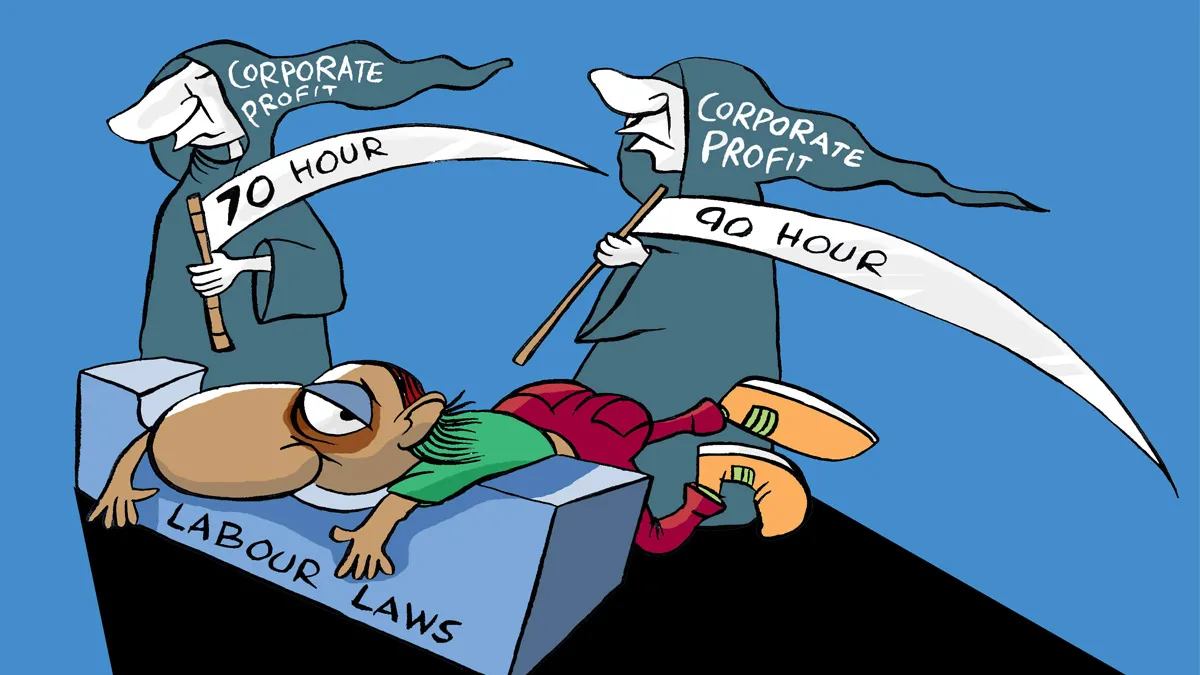
Uttam Ghosh gives us his unique take on the longer work hours debate.

Liquidity stress in smallcap funds has fallen to its lowest level since February 2024, with the average time to liquidate 50% of portfolios dropping to 27 days in June from a peak of 44.2 days in January 2026, driven by a sharp recovery in smallcap stocks and increased trading volumes.
Foreign Currency Non-Resident (Bank), or FCNR (B), deposits mobilised under the Reserve Bank of India's (RBI's) concessional swap facility may have already surpassed the amount raised during the 2013 scheme in just about 45 days, prompting SBI Research to sharply raise its estimate for inflows under the facility to $65-70 billion.

Analysts predict that the US-Iran geopolitical conflict, upcoming quarterly earnings announcements, and fluctuations in crude oil prices will be the primary drivers of investor sentiment in the Indian equity markets.

HDFC Bank's share in active mutual fund schemes has fallen to multi-year lows, despite overall MF ownership in the bank rising, as the stock faces weak performance, soft margins, and governance concerns.
Indian listed companies experienced their fastest revenue growth in 15 quarters during Q1FY27, with combined net sales rising 18.4% year-on-year, while net profit grew 16%, primarily driven by mining, metals, and banking sectors, despite a contraction in operating margins due to higher input costs.

The Reserve Bank of India has imposed a penalty of Rs 41.8 lakh on Canara Bank for non-compliance with KYC norms and incorrect account classification, and Rs 3.1 lakh on Puran Associates Pvt Ltd for asset classification violations.

Police in Sambhal, Uttar Pradesh, have registered a case against a postal assistant after suspicious transactions worth approximately Rs 4.5 crore were allegedly detected in his bank accounts.

Delhi Police have arrested a social media influencer for allegedly posting objectionable content targeting the family of the late businessman Sunjay Kapur.
India has significantly improved its position as a global foreign direct investment (FDI) destination, climbing two places to 11th in 2025, with inflows surging by nearly 44 per cent to $38.89 billion, according to the United Nations Conference on Trade and Development (Unctad) World Investment Report 2026.

The Supreme Court has directed the Reserve Bank of India to prepare a standard operating procedure (SOP) within four weeks to deal with bank accounts linked to cyber frauds, including mule accounts. This directive is part of a broader effort to strengthen responses to cyber-enabled financial frauds, with the court also urging states and UTs to adopt and operationalise grievance redressal and money restoration modules.

Tax collection so far has been encouraging, with net direct tax receipts reaching Rs 5.21 trillion by June 17, nearly a 15 per cent increase compared to the same period last year.

The Indian stock market's trajectory this week will be significantly influenced by crude oil prices, global market trends, and the commencement of the corporate earnings season, with IT major TCS set to announce its June-quarter results on July 9.

The Supreme Court has dismissed a review petition challenging its earlier decision that no cognisable offence was made out against BJP leaders Anurag Thakur and Parvesh Verma for their alleged hate speeches during the 2020 anti-CAA protests in Delhi.

Millions play cricket in India; only a few reach the IPL teams or the Indian team. Sometimes, a player may not get selected not due to lack of skill, at other times it may be due to team balance. But what every youngster should remember is that talent is permanent; selection is temporary, notes K R Nayar.

The Food Safety and Standards Authority of India (FSSAI) has issued notices to eight food business operators, including Emami Healthy & Tasty and Plan B, for using misleading brand names, trade names, and product claims that violate the Food Safety and Standards Act, 2006.
A police inspector with the Telangana Cyber Security Bureau has been arrested by the Anti-Corruption Bureau (ACB) for allegedly demanding and accepting a bribe to protect the family and friends of an individual booked in a cyber fraud case.

The Consumer Affairs Ministry is developing machine-readable SMART standards using AI to reduce industry compliance burden. This initiative aims to modernise India's standards ecosystem, with the Bureau of Indian Standards transitioning from a regulator to a facilitator, promoting private sector testing and faster processes.

Realty firm Unitech Ltd reported a consolidated net loss of Rs 441 crore for the quarter ended March 2026, compared to a net loss of Rs 309.95 crore in the year-ago period. The company faces a cash crunch and delays in housing projects, affecting around 22,000 customers.

Patan Police have busted a large-scale cyber fraud racket, arresting 14 individuals involved in illegal transactions worth Rs 398.43 crore through 13 'mule accounts'. The operation, dubbed "Operation Mule Hunt 2.0", uncovered a network linked to 228 inter-state cyber fraud complaints, where individuals were lured to open bank accounts used to channel proceeds of cyber crimes.

'Healthy double-digit returns are still possible, though a sharp rally is unlikely.'

The Food Safety and Standards Authority of India (FSSAI) has clarified that the display of expiry and 'best before' dates on packaged food products sold on e-commerce platforms is governed by the Legal Metrology (Packaged Commodities) Rules, 2011, which are administered by the Department of Consumer Affairs (DCA).
